CIA WORLD FACTBOOK DISAPPEARS FROM INTERNET WITHOUT NOTICE
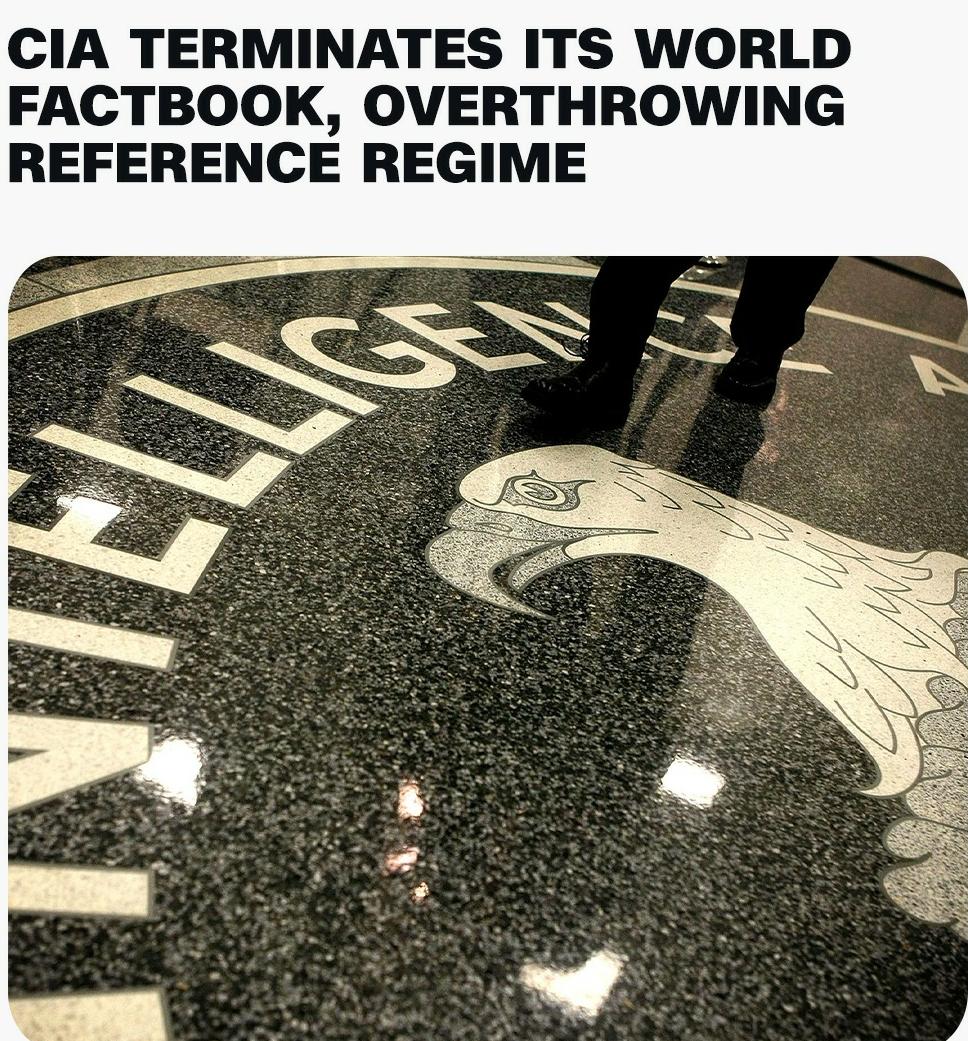
CIA WORLD FACTBOOK DISAPPEARS FROM INTERNET WITHOUT NOTICE
After more than 60 years as a cornerstone reference on global statistics, The World Factbook abruptly vanished from the web on February 4, 2026, shocking teachers, researchers, journalists and the public alike.WASHINGTON D.C. One of the most relied-upon sources of basic information about countries, their people, economies, governments, geography and statistics disappeared from the internet on February 4 with no advance notice, leaving researchers and educators scrambling for alternatives.
The CIA World Factbook a publication produced by the U.S. Central Intelligence Agency (CIA) for more than six decades was abruptly taken offline, ending its long-standing run as a free, public repository of authoritative global information. Users who sought the site were instead met with a blank or farewell message, according to reporting
On February 4, 2026, the online version of The World Factbook disappeared without warning, catching educators and researchers off-guard as they attempted to access country data
Teachers reported that students faced broken links and missing data during lessons that historically relied on the Factbook’s easy-to-use country profiles. Librarians and analysts noted that the publication had been a central source for trusted, comparable statistics on demographics, economies, and other vital facts.
Originally launched in 1962 as a classified internal reference called The National Basic Intelligence Factbook, the publication:
Evolved into an unclassified version in the 1970s and was made available to the public. Became The World Factbook in name and content, offering standardized country data across dozens of categories. Went online in 1997, where it became widely used by journalists, students, travelers, and academics around the world.
Was updated regularly and became a go-to free fact resource for quick comparative research. Its disappearance marks the end of an era for a tool that served as a foundation for global country information. Educators, librarians and researchers lamented the loss as a “tough blow” for access to reliable, centralized data:
Social studies teachers highlighted how the publication had been integral for student assignments on global GDP, population and other metrics. Public library specialists described the Factbook as an unmatched reference for demographic and developmental statistics.
Journalists noted the loss of a free and neutral data source they had historically used to inform reporting. Analysts say the sudden removal of the resource has created an immediate gap in widely accessible global data, prompting users to seek alternatives such as academic databases, encyclopedias or national statistical offices. The CIA posted a notice acknowledging the World Factbook’s history and legacy but provided no substantive explanation for taking it offline. The farewell message simply noted the end of the publication and encouraged users to continue exploring global information by other means. Officials did not clarify whether the Factbook will return in another form, be archived, or be replaced by a different reference tool leaving many users uncertain about where to find comparable free data going forward. Over the decades, The World Factbook became a staple reference because it:
Offered consistent, comparable country profiles on vital statistics including population, geography, economy and government structures. Was freely available to all, unlike many paid academic databases. Served as a trusted baseline for research, education and public information. Its disappearance without warning has highlighted concerns about access to reliable public data in a digital era where many historic resources are no longer guaranteed to remain online. After more than 60 years as a cornerstone reference on global statistics, The World Factbook abruptly vanished from the web on February 4, 2026, shocking teachers, researchers, journalists and the public alike WASHINGTON D.C. One of the most relied-upon sources of basic information about countries, their people, economies, governments, geography and statistics disappeared from the internet on February 4 with no advance notice, leaving researchers and educators scrambling for alternatives.
The CIA World Factbook a publication produced by the U.S. Central Intelligence Agency (CIA) for more than six decades was abruptly taken offline, ending its long-standing run as a free, public repository of authoritative global information. Users who sought the site were instead met with a blank or farewell message, according to reporting
On February 4, 2026, the online version of The World Factbook disappeared without warning, catching educators and researchers off-guard as they attempted to access country
Teachers reported that students faced broken links and missing data during lessons that historically relied on the Factbook’s easy-to-use country profiles.Librarians and analysts noted that the publication had been a central source for trusted, comparable statistics on demographics, economies, and other vital facts.
Originally launched in 1962 as a classified internal reference called The National Basic Intelligence Factbook, the publication:
Evolved into an unclassified version in the 1970s and was made available to the public. Became The World Factbook in name and content, offering standardized country data across dozens of categories. Went online in 1997, where it became widely used by journalists, students, travelers, and academics around the world.
Was updated regularly and became a go-to free fact resource for quick comparative research.Its disappearance marks the end of an era for a tool that served as a foundation for global country information. Educators, librarians and researchers lamented the loss as a “tough blow” for access to reliable, centralized data:
Social studies teachers highlighted how the publication had been integral for student assignments on global GDP, population and other metrics. Public library specialists described the Factbook as an unmatched reference for demographic and developmental statistics.
Journalists noted the loss of a free and neutral data source they had historically used to inform reporting.
Analysts say the sudden removal of the resource has created an immediate gap in widely accessible global data, prompting users to seek alternatives such as academic databases, encyclopedias or national statistical offices. The CIA posted a notice acknowledging the World Factbook’s history and legacy but provided no substantive explanation for taking it offline. The farewell message simply noted the end of the publication and encouraged users to continue exploring global information by other means.
Officials did not clarify whether the Factbook will return in another form, be archived, or be replaced by a different reference tool leaving many users uncertain about where to find comparable free data going forward. Over the decades, The World Factbook became a staple reference because it: Offered consistent, comparable country profiles on vital statistics including population, geography, economy and government structures. Was freely available to all, unlike many paid academic databases. Served as a trusted baseline for research, education and public information.Its disappearance without warning has highlighted concerns about access to reliable public data in a digital era where many historic resources are no longer guaranteed to remain online.