Evergrande Founder Hui Ka Yan Sentenced To Life In Prison
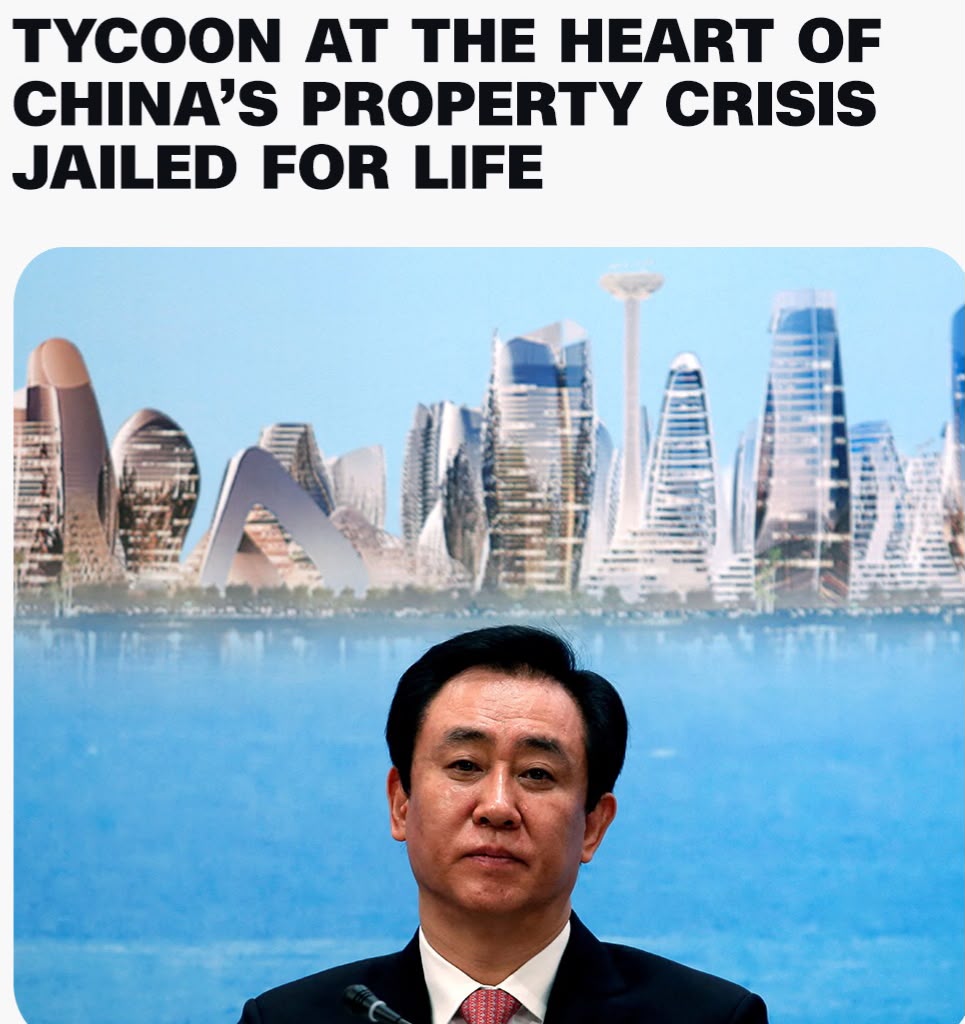
Evergrande Founder Hui Ka Yan Sentenced to Life in Prison Hui Ka Yan, the founder of Chinese property giant Evergrande, has been sentenced to life imprisonment by a court in Shenzhen, marking a dramatic end to the rise and fall of one of China’s most powerful property tycoons. The 67-year-old businessman, also known as Xu Jiayin, was found guilty of multiple financial crimes after the collapse of Evergrande became one of the defining events of China’s prolonged property crisis. The court also ordered the confiscation of all of Hui’s personal property and stripped him of his political rights for life. Hui pleaded guilty in April to eight charges, including misuse of funds, fundraising fraud, illegally taking public deposits, illegal lending, fraudulent securities issuance and bribery. Chinese authorities said that between 2016 and 2021, Evergrande and Hui engaged in large-scale financial fraud, including inflating the company’s assets and concealing its liabilities. The court described the offences as involving exceptionally large sums of money and causing serious economic and social harm The punishment extended beyond Hui personally. Evergrande Group was fined 8.82 billion yuan 1.31 billion, while its property subsidiary, Evergrande Real Estate Group, was ordered to pay another 7 billion yuan $1.04 billion. More than 50 other people connected to the case were also sentenced, with several senior Evergrande executives receiving prison terms of between six and 18 years Hui’s downfall represents one of the most dramatic reversals in modern Chinese business. He founded Evergrande in 1996 and built it into China’s largest property developers through an aggressive expansion strategy heavily dependent on borrowing. At his peak in 2017, Forbes estimated his fortune at about $45.3 billion, making him Asia’s richest person at the time. Evergrande eventually grew into an enormous property empire, with annual sales reaching around 700 billion yuan $100 billion in 2020. But the company’s rapid, debt-fuelled expansion left it dangerously exposed when Chinese authorities introduced measures aimed at reducing excessive borrowing in the property sector. Evergrande defaulted on its debts in 2021, triggering a crisis that spread throughout China’s property industry. The company had accumulated more than $300 billion in liabilities, making its collapse one of the world’s largest corporate debt failures. The fallout went far beyond the company itself. Developers struggled to complete housing projects, homeowners protested over unfinished properties and investors faced significant losses. Evergrande subsequently entered liquidation proceedings after a Hong Kong court ordered its winding-up in 2024. Evergrande’s collapse became a symbol of the wider problems facing China’s real-estate sector. For years, property development had been a major engine of China’s economic growth. But excessive borrowing, falling demand and tighter government controls exposed vulnerabilities across the industry. The resulting downturn has continued to weigh on China’s economy, with other major developers also facing severe financial difficulties. Although Hui’s conviction represents a major legal conclusion to the Evergrande saga, it does not automatically resolve the enormous financial losses suffered by creditors. Evergrande’s liquidators are still attempting to recover assets and distribute proceeds to creditors. Reuters reported that the sentence is unlikely by itself to provide significant relief to the company’s domestic and overseas creditors, many of whom remain exposed to substantial losses. Hui’s journey from a rural upbringing to one of China’s wealthiest businessmen, followed by his imprisonment, mirrors the extraordinary rise and subsequent collapse of China’s property boom. Evergrande’s spectacular expansion demonstrated the opportunities created by China’s real-estate growth while its collapse exposed the dangers of unchecked debt and aggressive expansion. His life sentence now places a definitive punctuation mark on one of the biggest corporate scandals in China’s recent history.