Why Europe Still Has So Little Air Conditioning Despite Rising Heatwaves
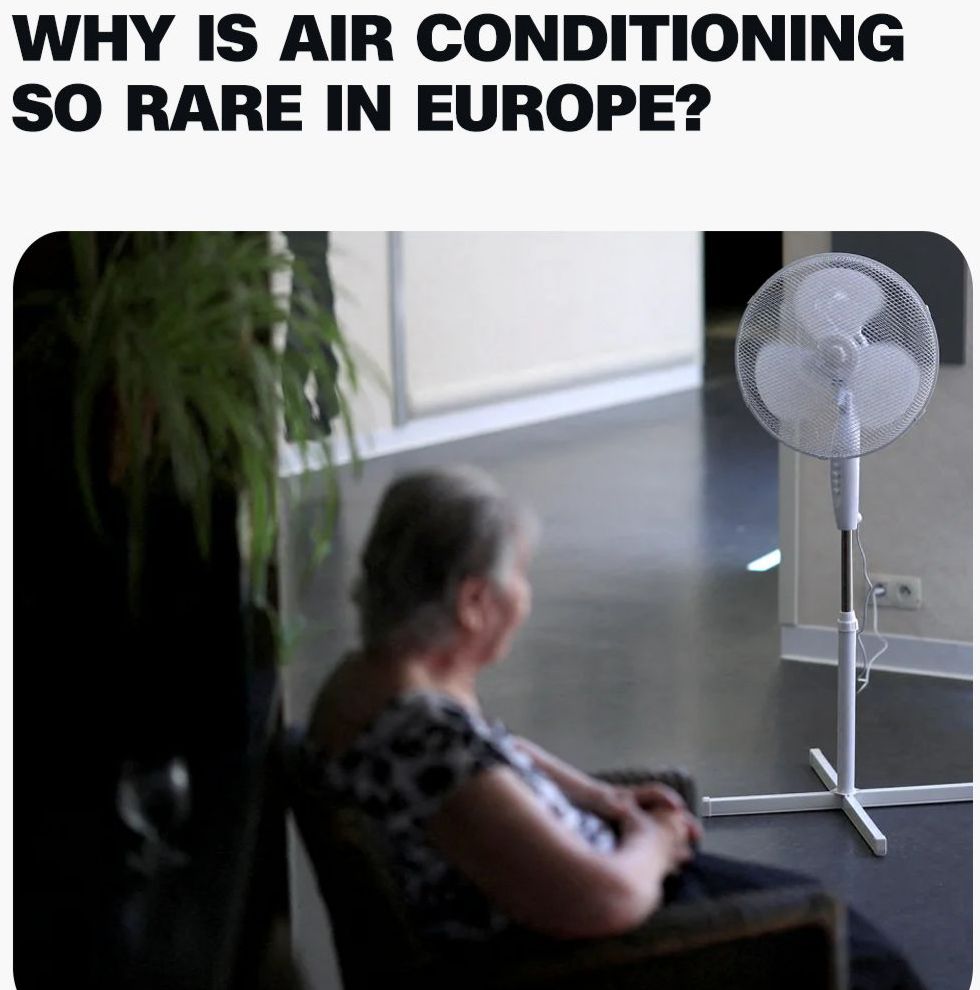
Why Europe Still Has So Little Air Conditioning Despite Rising Heatwaves As Europe endures increasingly severe and prolonged heatwaves, one striking difference between the continent and the United States remains unchanged: air conditioning is still uncommon in most European homes. While nearly 90% of households in the United States are equipped with air conditioning, only about one in five homes across Europe has AC, according to industry estimates. The gap has become more noticeable as climate change drives hotter summers, pushing temperatures to record levels and raising concerns about public health, infrastructure and energy security. Scientists say Europe is warming faster than the global average, leading to more frequent, longer-lasting and more intense heatwaves. In recent years, countries including Spain, Italy, France, Greece and the United Kingdom have experienced record-breaking temperatures, wildfires and heat-related deaths. The continent’s latest heatwave has once again highlighted the challenge many Europeans face in keeping their homes cool. Unlike in the United States, where air conditioning is considered a standard household appliance, many European residents rely on fans, shutters, thick walls and natural ventilation to cope with extreme heat. Experts point to several reasons why air conditioning adoption has historically remained low across Europe. For decades, much of Europe enjoyed relatively mild summers, reducing the need for mechanical cooling. Many homes were designed to retain heat during cold winters rather than expel it during hot summers. European cities also tend to have older buildings, including historic structures protected by preservation laws that can make installing external air-conditioning units difficult or expensive. Energy costs have also played a role. Electricity prices in many European countries are significantly higher than in the United States, making air conditioning more costly to operate. Environmental concerns have further influenced consumer behavior. Air conditioners consume large amounts of electricity and can contribute to greenhouse gas emissions if powered by fossil fuels. Many European governments have encouraged energy efficiency measures instead of widespread cooling systems. Despite these barriers, demand for air conditioning is increasing rapidly. Manufacturers report rising sales across Southern and Western Europe as households seek protection from hotter summers. In countries such as Spain, Italy and Greece, AC ownership rates are substantially higher than the European average, while cooler northern nations are also beginning to see increased installations. Climate researchers warn that access to cooling is becoming a public health issue rather than simply a matter of comfort. Heat-related illnesses can disproportionately affect elderly people, young children and those with underlying health conditions. Governments and urban planners are increasingly exploring alternatives to traditional air conditioning. Strategies include improving building insulation, planting more trees, expanding green spaces, installing reflective roofs and redesigning cities to reduce the urban heat-island effect. Some experts argue that Europe will ultimately need more air conditioning as temperatures continue to rise, but they stress that future systems must be energy-efficient and powered by cleaner sources of electricity. The challenge for policymakers is balancing the growing need for cooling with efforts to reduce carbon emissions and meet climate targets.
As extreme heat becomes more common across Europe, the continent faces a difficult question: how to keep millions of people safe during increasingly dangerous summers without significantly increasing energy consumption. For now, air conditioning remains far less common in Europe than in the United States. But with heatwaves becoming longer, more frequent and more intense, that gap may not remain as large in the decades ahead.
- Nearly 90% of US homes have air conditioning, compared with roughly 20% of homes in Europe.
- Europe is experiencing increasingly frequent and intense heatwaves linked to climate change.
- Historically mild summers, older buildings, higher energy costs and environmental concerns have limited AC adoption.
- Demand for air conditioning is rising across many European countries.
- Experts increasingly view cooling as a public health necessity during extreme heat events.
- Governments are pursuing both air-conditioning expansion and alternative cooling solutions to balance climate goals and public safety.