Verified Footage Emerges
Verified Footage Emerges
Recent verified videos and footage from Iran authenticated Verify and other independent analysts show horrific scenes from the aftermath of nationwide anti-government protests, including:
Bodies piled inside a hospital mortuary, with at least 31 corpses seen in one verified clip.
Body bags laid outside hospital entrances, indicating mass casualties.
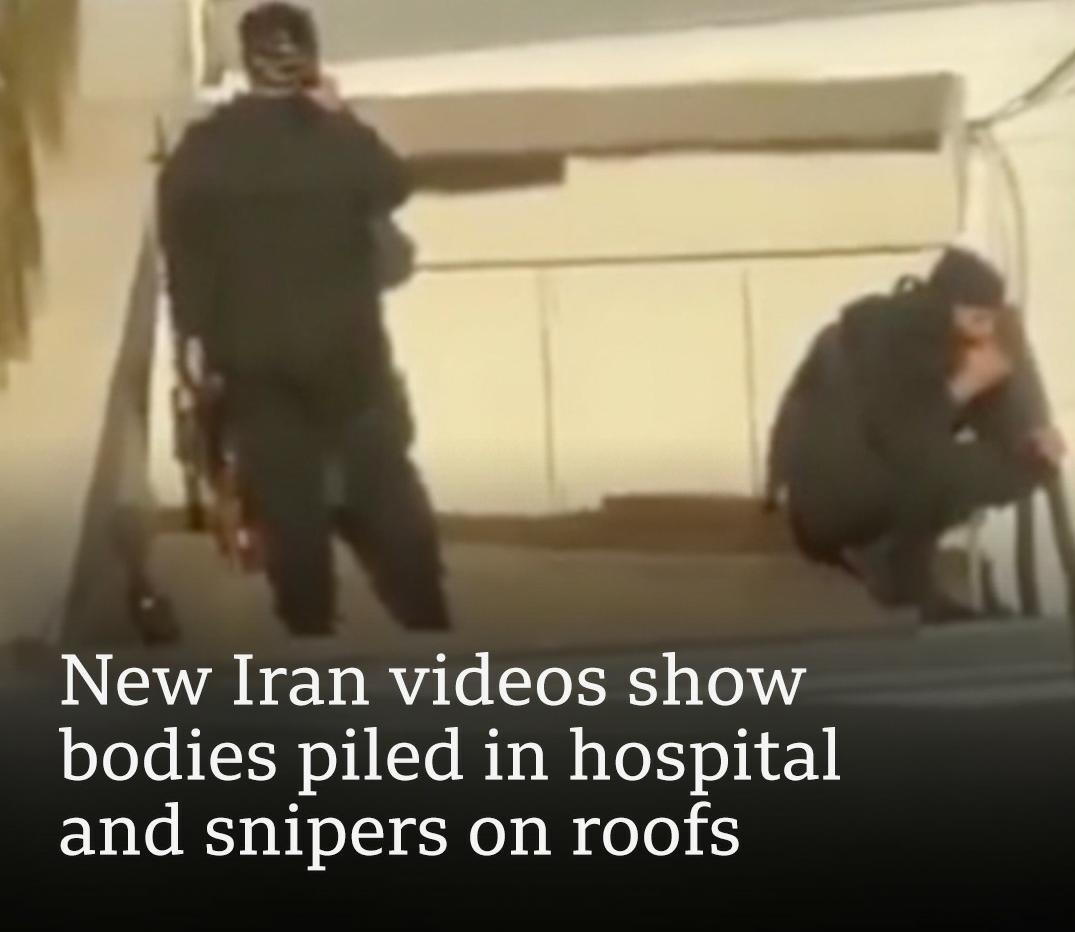
Snipers stationed on building rooftops, including armed men with rifles positioned above crowds.
Protesters attacking and destroying CCTV surveillance cameras in attempts to evade state monitoring and record events.
These videos are understood to have been filmed on 8 and 9 January 2026, which are widely regarded as the deadliest days of the protests so far as demonstrators across the country responded to calls for nationwide action. The unrest began in late December 2025 with anti-government demonstrations spreading across many cities following a call for nationwide protests by Reza Pahlavi, the exiled son of Iran’s last shah. Authorities responded with extreme force, deploying security forces including the Islamic Revolutionary Guard Corps (IRGC) and other militia groups amid a near-total internet shutdown that has greatly limited independent reporting from inside the country.
Local Iranian official figures acknowledge around 3,100 deaths, claiming many were security personnel or bystanders caught up in “riots.” Independent organisations like the Human Rights Activists News Agency (HRANA) say they have confirmed nearly 6,000 deaths, mostly protesters, with tens of thousands of additional reports under investigation despite the communication blackout.
Human rights groups warn that the final death toll could be far higher, with some estimates reaching well into the tens of thousands as more evidence and reports surface. The verified footage and rights-group reports paint a picture of a brutal crackdown:
Crowds of protesters seen on highways and streets before repeated gunfire erupts, causing panic and chaos.
Armed individuals in military attire are captured firing weapons in some cities, though it is difficult to independently identify whether they are official forces, plainclothes units, or others.
Protesters are shown trying to disable CCTV cameras, suggesting widespread distrust of state surveillance and an effort to document government actions despite intense monitoring.
Since early January, Iran has enforced a near-total internet blackout, severely restricting the ability of journalists, rights groups and ordinary citizens to share real-time images, video or credible information from inside the country. Some footage has nonetheless been transmitted using tools like VPNs and satellite internet services, allowing rare documentation of events despite major restrictions.
Verified visual evidence is crucial because Iran’s communication shutdown has made it extremely difficult to independently confirm events. The footage and subsequent analyses provide some of the clearest documentation yet of the scale and severity of the state’s response to protests. Millions worldwide continue to express concern over human rights violations, mass killings and suppression of dissent in one of the most intense protest crackdowns in Iran’s recent history.