Remains Of Legendary French Musketeer D’Artagnan May Have Been Found Under Dutch Church
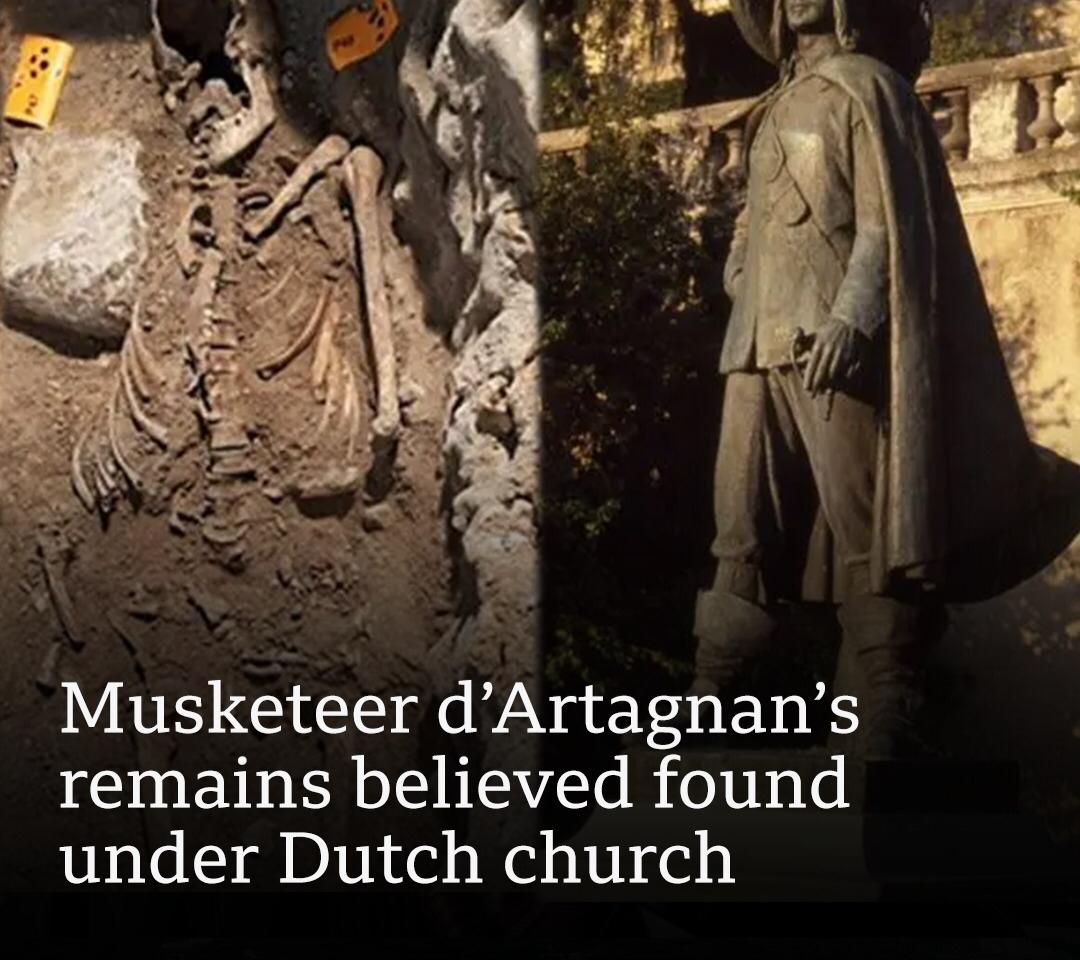
Remains of legendary French musketeer d’Artagnan may have been found under Dutch church Discovery beneath Maastricht church sparks global interest as scientists begin DNA tests to confirm identity More than 350 years after his death, the remains of the legendary French musketeer d’Artagnan may have been discovered beneath a church in the Netherlands.
Archaeologists say a skeleton found under the floor of St Peter and Paul Church in Maastricht could belong to Charles de Batz de Castelmore the real-life soldier who inspired Alexandre Dumas’ famous novel The Three Musketeers.
The remains were uncovered after part of the church floor collapsed during repair work, revealing a burial site near the altar a location historically reserved for important or noble individuals.
Experts believe the discovery aligns with historical accounts of d’Artagnan’s death. He was killed in 1673 during the Siege of Maastricht while serving King Louis XIV, reportedly struck by a musket ball in the throat.
- A musket ball fragment discovered near the body, consistent with how he died
- A French coin dated around 1660, matching the time period
- Burial beneath the altar, indicating high status
- Location close to the historic battlefield where he died
Archaeologists say these elements strongly support the theory but stress that confirmation is not yet certain.
DNA testing is now being carried out to verify the identity of the remains. Samples taken from the skeleton will be compared with those of known descendants of d’Artagnan’s family.
Researchers are also conducting further analyses, including carbon dating and biological profiling, to determine the age, origin, and sex of the individual. Experts involved in the investigation have described it as a “top-level” international effort, reflecting the historical significance of the find.
D’Artagnan was a real 17th-century French soldier and captain of the Musketeers of the Guard, later immortalised in literature as the daring hero of The Three Musketeers. Although his exploits became legendary through fiction, his actual burial site had remained a mystery for centuries until now.
- Solve a 350-year-old historical mystery
- Provide rare insight into a famous historical figure behind a literary icon
- Potentially turn the church site into a major cultural and tourist attraction For now, scientists are urging caution. While the evidence is compelling, only DNA results will determine whether the remains truly belong to d’Artagnan.
Until then, one of history’s most famous musketeers remains quite literally a mystery beneath the surface.