ITALY’S ICONIC “LOVERS’ ARCH” COLLAPSES ON VALENTINE’S DAY DURING HEAVY STORMS
ITALY’S ICONIC “LOVERS’ ARCH” COLLAPSES ON VALENTINE’S DAY DURING HEAVY STORMS
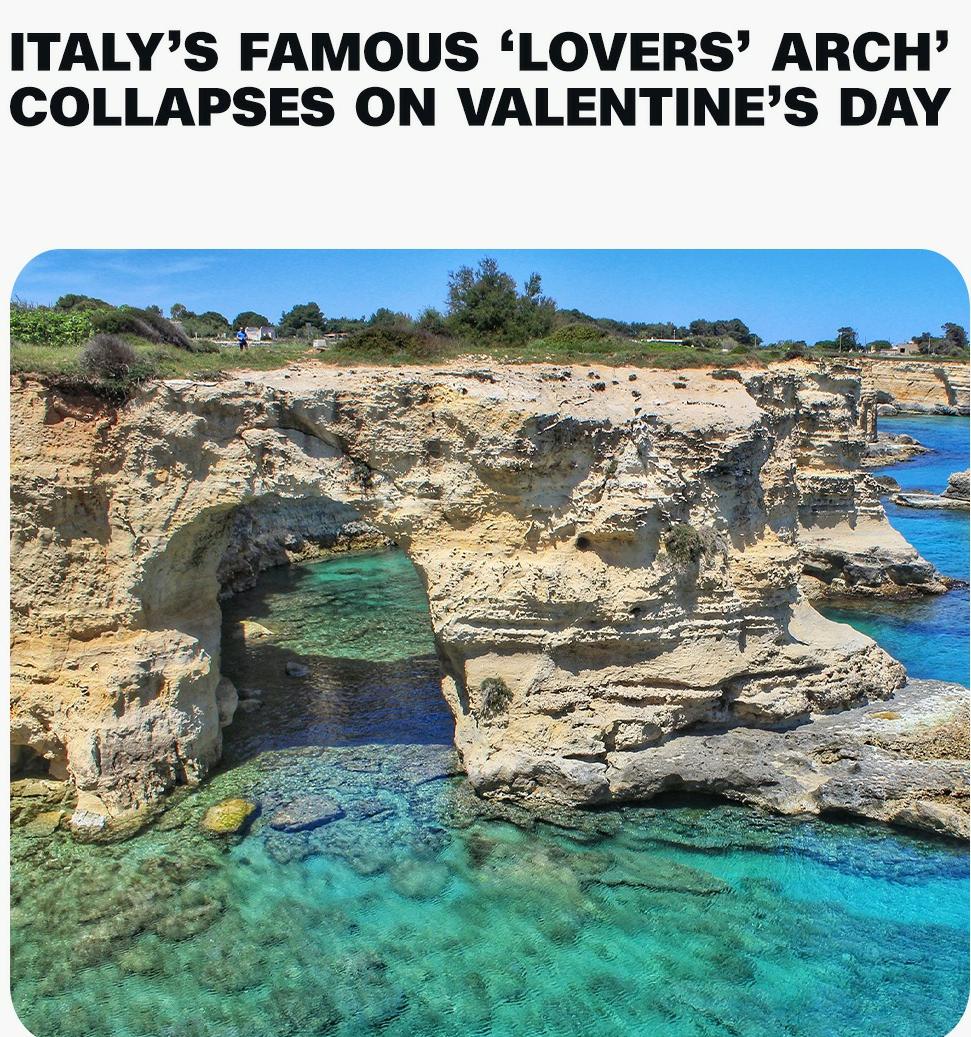
An Italian coastal beauty spot famed for its romantic appeal the natural “Lovers’ Arch” collapsed into the Adriatic Sea on Valentine’s Day 2026 after being battered by days of severe storms and turbulent weather, local officials and eyewitness reports say. What one mayor called “a blow to the heart” has stunned residents, tourists and lovers who long made the landmark a symbol of romance. The Lovers’ Arch a naturally formed rock arch at Faraglioni di Sant’Andrea, near the town of Melendugno in Italy’s Puglia region collapsed on February 14, 2026 after enduring heavy rain, strong winds and rough seas over several days.
The fragile limestone formation was reduced to rubble during the powerful storm system that swept across southern Italy, and the arch was noticed missing by visitors the next morning.
The site had long been a romantic magnet for courting couples and tourists, with local legend holding that couples who kissed beneath the arch would enjoy eternal love.
It was a popular backdrop for wedding proposals, anniversaries and photographs a free, easily accessible natural attraction that drew visitors from Italy and abroad. Maurizio Cisternino, Mayor of Melendugno, described the loss as “a blow to the heart” and a “devastating blow to the image of Salento and to tourism.” He said the arch’s collapse will have emotional and economic impacts on the region. Cisternino added that while its eventual destruction might have been expected due to centuries of natural weathering, the recent storms accelerated the collapse far sooner than anticipated. Local tourism leaders likened the scene to a funeral for a cherished landmark. The arch was formed over centuries of coastal erosion, as the Adriatic Sea’s winds and waves carved the rock. Recent Storm Oriana and other severe weather patterns brought intense rainfall and powerful sea surges that weakened the already fragile structure, triggering its collapse.
Experts have noted visible cracks along other stretches of the rocky coastline, raising fears that additional formations could also succumb to erosion and extreme weather. The collapse highlights broader concerns over coastal erosion and climate‑linked extreme weather in the Mediterranean.
Storms in recent weeks have inflicted widespread damage across southern Italy, with beach structures weakened, parts of the Ionian coastline damaged, and beach cliff falls reported from Ugento to Gallipoli. In neighboring Sicily, a major landslide in the town of Niscemi forced more than 1,500 residents to evacuate as homes and infrastructure were threatened part of a spate of storm damage in early 2026. The Salento region is one of Italy’s most popular tourist areas, and the arch’s collapse removes a beloved scenic landmark that boosted visits and local spending.
Officials and business owners fear that losing such a visually striking and symbolic attraction could affect tourism as travelers seek other destinations. The sudden loss of Lovers’ Arch is both symbolic and practical emblematic of how fragile natural features can be quickly erased by intensifying weather patterns, and a reminder of the economic vulnerability of tourism‑dependent regions to climate change and extreme storms. It underscores a wider call for coastal preservation and environmental planning in the face of evolving natural threats.