Humanoid Robots Break Usain Bolt’s Record At Beijing Robot Games
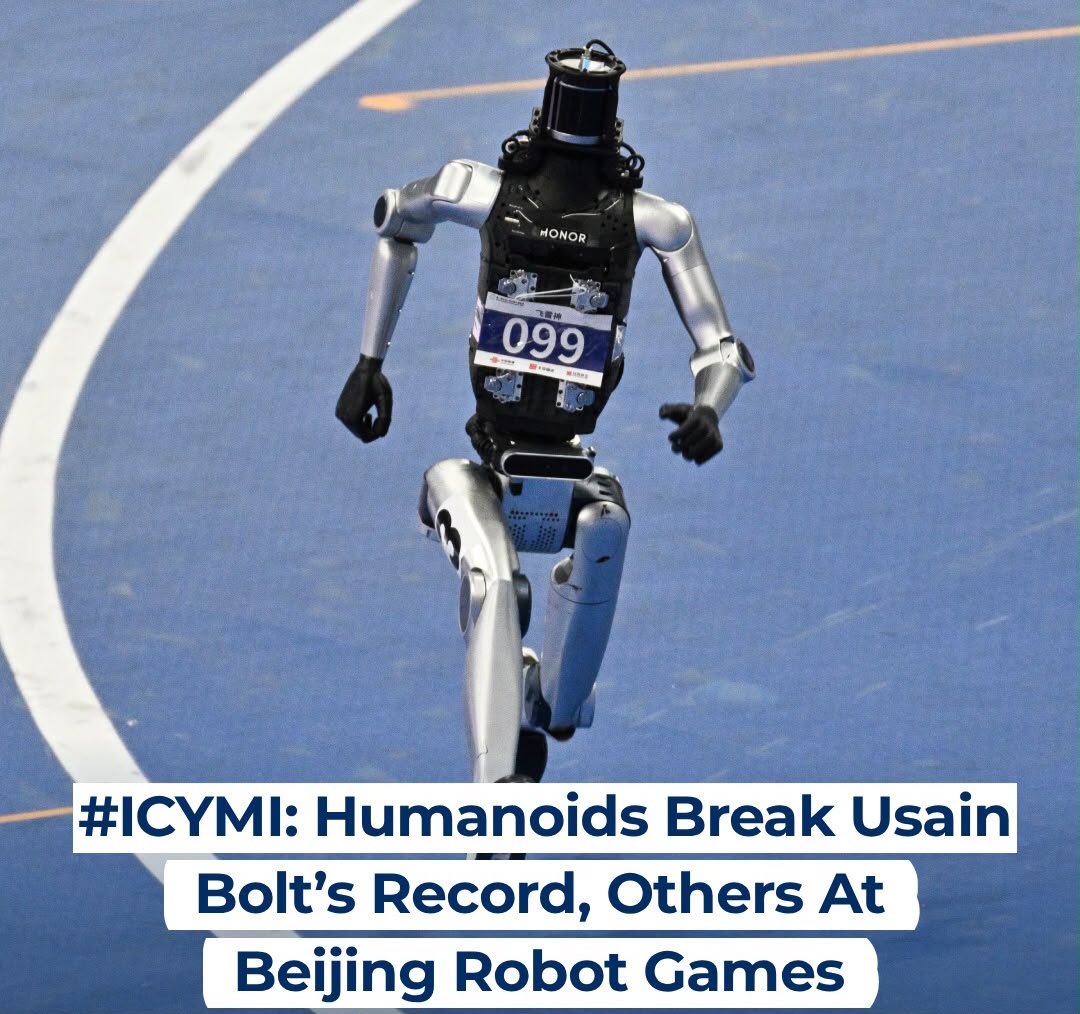
Humanoid Robots Break Usain Bolt’s Record at Beijing Robot Games
Humanoid robots have made headlines at the World Humanoid Robot Games in Beijing, breaking records previously held by humans and showcasing China’s rapid advances in robotics technology. Dozens of humanoid robots and their human operators gathered at Beijing’s Olympic speed skating arena over the weekend to compete in events including athletics, boxing, football and martial arts. The biggest headline came from Tiangong Ultra, a white, headless humanoid robot developed by a Beijing government-backed research centre. The robot completed the 100-metre sprint in 9.39 seconds, surpassing Jamaican sprint legend Usain Bolt’s 9.58-second world record, set in 2009. The same robot later produced another remarkable performance in the 400 metres, finishing in 38.15 seconds. The time was nearly five seconds faster than the human world record of 43.03 seconds held by South Africa’s Wayde van Niekerk. The performances attracted large crowds, with spectators cheering the robots as they raced around the track. However, not every machine performed flawlessly. Several robotic runners failed to start, while others moved at little more than walking pace or collapsed shortly after the race began. In the football competition, a toddler-sized robot sent the ball over a knee-high barrier, drawing laughter and applause from spectators. A humanoid competing in the boxing event also stumbled out of the ring and became motionless before human operators had to carry it away. Despite the mishaps, the event demonstrated the rapid development of humanoid robotics in China. More than 2,000 robots from hundreds of teams are taking part in this year’s expanded competition, which features both sporting events and practical tasks designed to test robots’ capabilities. The organisers are using the games to showcase advances in robotics, while China increasingly positions the sector as an important part of its technological and industrial ambitions. For some spectators, however, speed records are only part of the challenge. One Beijing spectator, Hou Yali, said she would like to see robots tested on more practical tasks such as cleaning homes and preparing meals. She noted that the current competitions demonstrate speed and physical ability but do not necessarily show whether robots can genuinely match humans in intelligence or everyday tasks. The World Humanoid Robot Games therefore offer a striking picture of both the progress and limitations of modern robotics: machines capable of running faster than the fastest humans, yet still struggling with basic coordination and balance.