Canada Pursues ‘Unique Alliance’ With EU As Carney Seeks To Reduce US Dependence
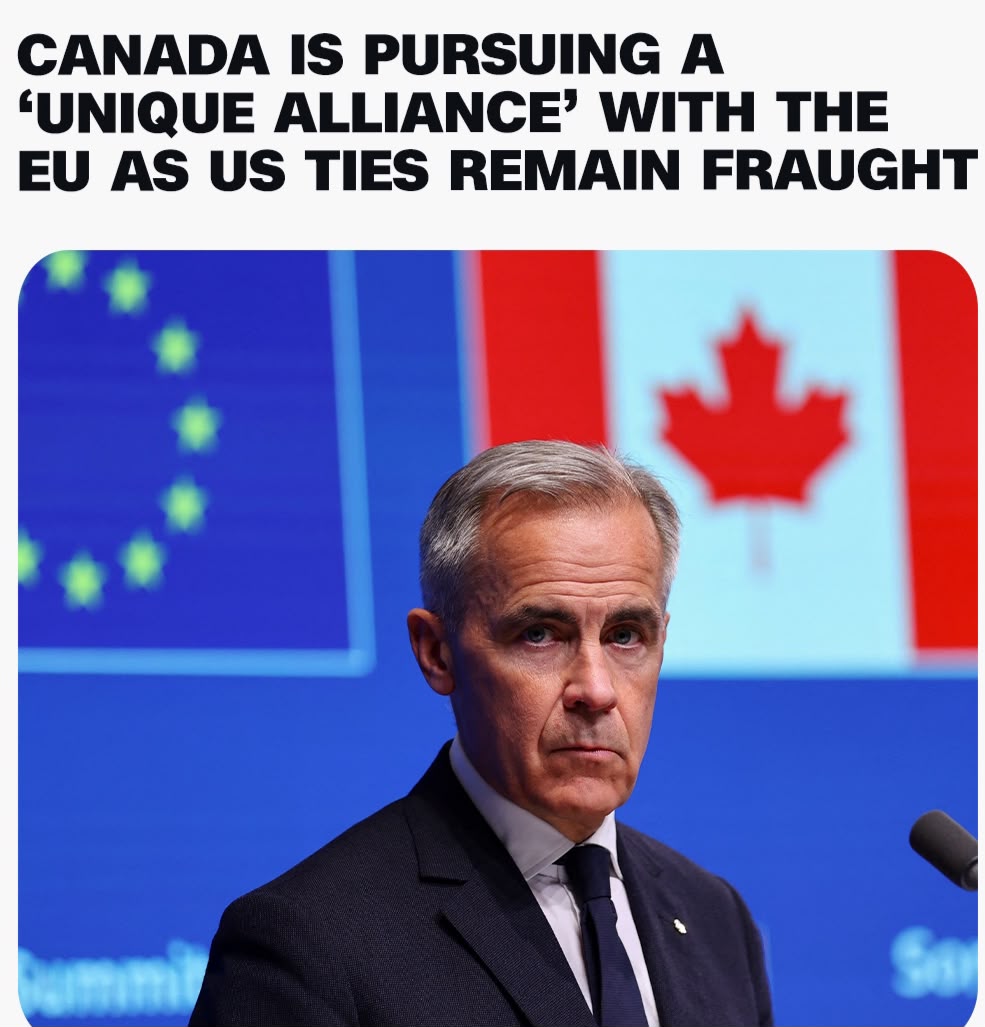
Canada Pursues ‘Unique Alliance’ With EU as Carney Seeks to Reduce US Dependence Canadian Prime Minister Mark Carney has announced plans to pursue a “unique alliance” with the European Union, as Ottawa accelerates efforts to diversify its economic and strategic relationships amid an escalating trade dispute with the United States. Carney said Canada was not seeking membership of the 27-nation bloc but wanted to establish an unprecedented level of cooperation based on shared values, common priorities and complementary economic strengths. The proposed partnership represents a significant shift in Canada’s foreign and economic strategy as tensions with Washington continue to strain one of the world’s most important bilateral trading relationships. Carney made clear that Canada does not intend to become an EU member.
“We’re not looking to become a member of the European Union,” he said while speaking to reporters at the Toronto International Film Festival. Instead, he said Ottawa would begin discussions with Brussels on what he described as a “unique alliance” between Canada and the EU.Carney argued that Canada and Europe share democratic values and priorities while possessing economic strengths that complement each other. The move comes as Canada’s relationship with the United States has deteriorated under President Donald Trump, with tariffs and threats of additional trade restrictions putting pressure on Canadian businesses. Trump has repeatedly criticized Canada’s trade policies and has threatened further tariffs on Canadian automobiles and other products. Carney has responded by emphasizing the need for Canada to become less economically dependent on its southern neighbour and build stronger relationships with other major economies. Canada currently sends the majority of its exports to the United States, making diversification a major priority for Ottawa. Discussions between Canada and the EU are expected to extend well beyond conventional trade.
- Energy and critical minerals
- Artificial intelligence and advanced technology
- Defence and security
- Digital infrastructure
- Data centres and cloud storage
- Satellite networks
- Undersea cables
- Investment and supply-chain security
- Greater movement of Canadian goods, services and workers
The two sides are also exploring ways to make it easier for Canadians to live and work in Europe, although the precise framework for such arrangements remains under discussion. Carney is travelling to Europe this week for high-level discussions aimed at strengthening Canada’s relationship with the bloc. He is scheduled to address the European Parliament in Strasbourg and attend European Commission President Ursula von der Leyen’s State of the Union address. He will also hold talks with European leaders, including French President Emmanuel Macron, as Canada seeks deeper cooperation in areas such as defence, energy, critical minerals and advanced technologies. The European Union has also taken steps to strengthen its relationship with Ottawa, including Canada’s participation in its Security Action for Europe (SAFE) defence initiative. The European Union has signalled that it is receptive to creating a relationship with Canada that goes beyond existing arrangements. EU ambassador to Canada Geneviève Tuts said the bloc was working on a partnership unlike those it currently maintains with countries such as Switzerland, Norway and the United Kingdom. “What we have in mind is something different from what we have with other countries,” Tuts said. “That will be something unique. However, officials have stressed that the details are still being developed and that no major agreement is expected immediately. Reports have suggested that Canada could eventually receive some form of “associate membership” status within the EU. Carney, however, has not endorsed that description and has instead emphasized the broader concept of a unique alliance. The EU has also indicated that any new arrangement would require discussions among member states before it could be formally adopted. A potential announcement could come at an EU-Canada summit scheduled for late October. The proposed alliance reflects Ottawa’s broader effort to reduce its vulnerability to decisions made in Washington. Carney has argued that Canada must develop new economic relationships and strengthen its domestic capacity rather than relying overwhelmingly on the US market. The European Union is seen as one of the most natural partners because of its large economy, shared democratic values and demand for resources such as energy and critical minerals. EU-Canada trade was worth about $147 billion in 2025, highlighting the potential for further expansion. Canada’s push for a deeper European relationship does not necessarily mean Ottawa is abandoning Washington. The proposed “unique alliance” with Europe could therefore become one of the most significant elements of Canada’s foreign-policy recalibration, strengthening ties with another major economic bloc while giving Ottawa greater room to manoeuvre in its increasingly difficult relationship with Washington.