Poorly Designed Roads, Public Facilities Leave Persons With Disabilities Stranded
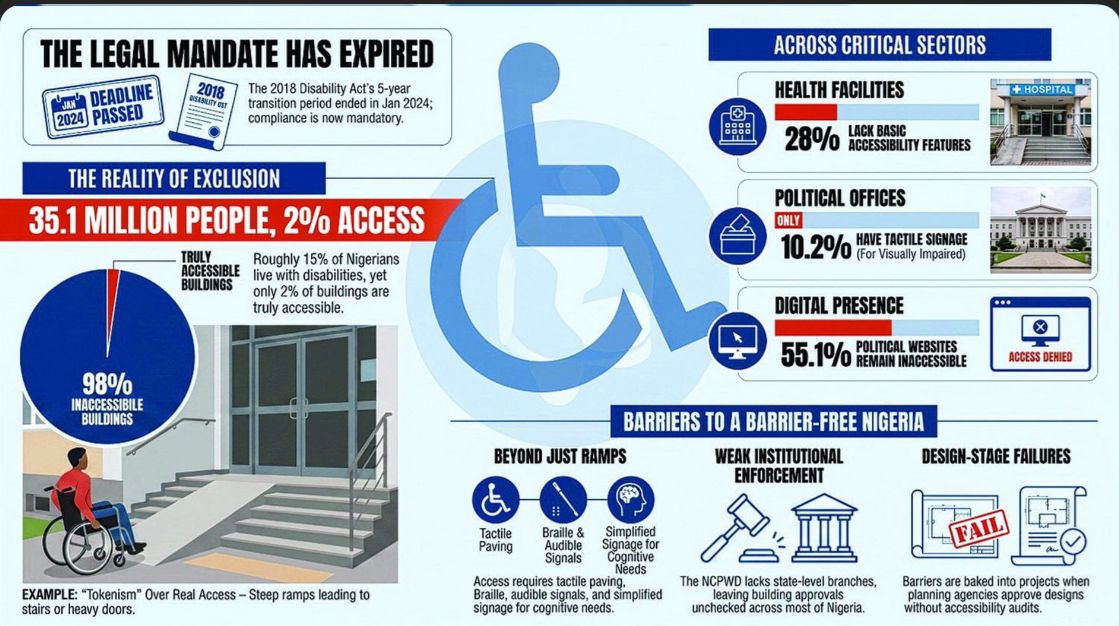
Poorly Designed Roads, Public Facilities Leave Persons With Disabilities Stranded Despite increasing investment in roads, housing, commercial buildings and other public infrastructure, persons with disabilities PWDscontinue to face significant barriers because many newly constructed facilities fail to incorporate basic accessibility features. found that people living with disabilities are frequently left unable to independently access roads, public buildings, healthcare centres and other essential facilities because of poor design and inadequate enforcement of accessibility standards. The situation has raised concerns among disability advocates and other stakeholders, who say infrastructure development should not be measured only by the number or quality of projects completed, but also by whether those facilities can be safely and conveniently used by everyone. According to the report, only about two per cent of buildings in Nigeria are accessible to people with disabilities, while approximately 28 per cent of health facilities lack basic accessibility features. For many PWDs, features that should be standard in modern infrastructure including ramps, accessible entrances, appropriate walkways, handrails, elevators and accessible toilets remain unavailable or poorly designed. Road infrastructure presents another major challenge. Poorly constructed walkways, open drainage channels, high kerbs and the absence of properly designed pedestrian crossings can make movement extremely difficult for people who use wheelchairs, walking aids or other mobility devices. In some cases, newly completed roads and public spaces may appear modern but still fail to provide continuous, safe routes for people with disabilities. The consequences extend beyond inconvenience. Limited access to public infrastructure can restrict PWDs’ ability to work, attend school, obtain healthcare, access government services and participate fully in economic and social activities. Stakeholders therefore want greater attention paid to accessibility at the design and planning stages of infrastructure projects rather than attempting to make facilities accessible after construction has been completed. They also called for stronger enforcement of existing disability and building regulations, arguing that contractors and developers should face consequences when projects fail to meet established accessibility requirements.
Some operators and disability advocates have advocated penalties and the sealing of facilities that do not comply with accessibility standards.The concerns come despite the existence of Nigeria’s legal framework for protecting the rights of persons with disabilities. Stakeholders say the challenge is increasingly one of implementation, monitoring and enforcement. They urged federal, state and local authorities to ensure that accessibility requirements are included in project specifications and tender documents and are independently verified before facilities are approved for use.
They also called for people with disabilities to be involved in infrastructure planning and inspection, saying their direct experiences can help identify barriers that may be overlooked by architects, engineers and government officials. The campaign for accessible infrastructure is ultimately about ensuring that development benefits all Nigerians. As investment in roads, housing and public facilities continues, disability advocates argue that a project cannot truly be described as successful if a significant section of the population cannot use it safely and independently. The growing concerns have therefore renewed calls for inclusive design to become a compulsory component of Nigeria’s infrastructure development, rather than an optional feature added after projects are completed.