Starmer Says Mandelson ‘Should Not Be A Member Of The House Of Lords’
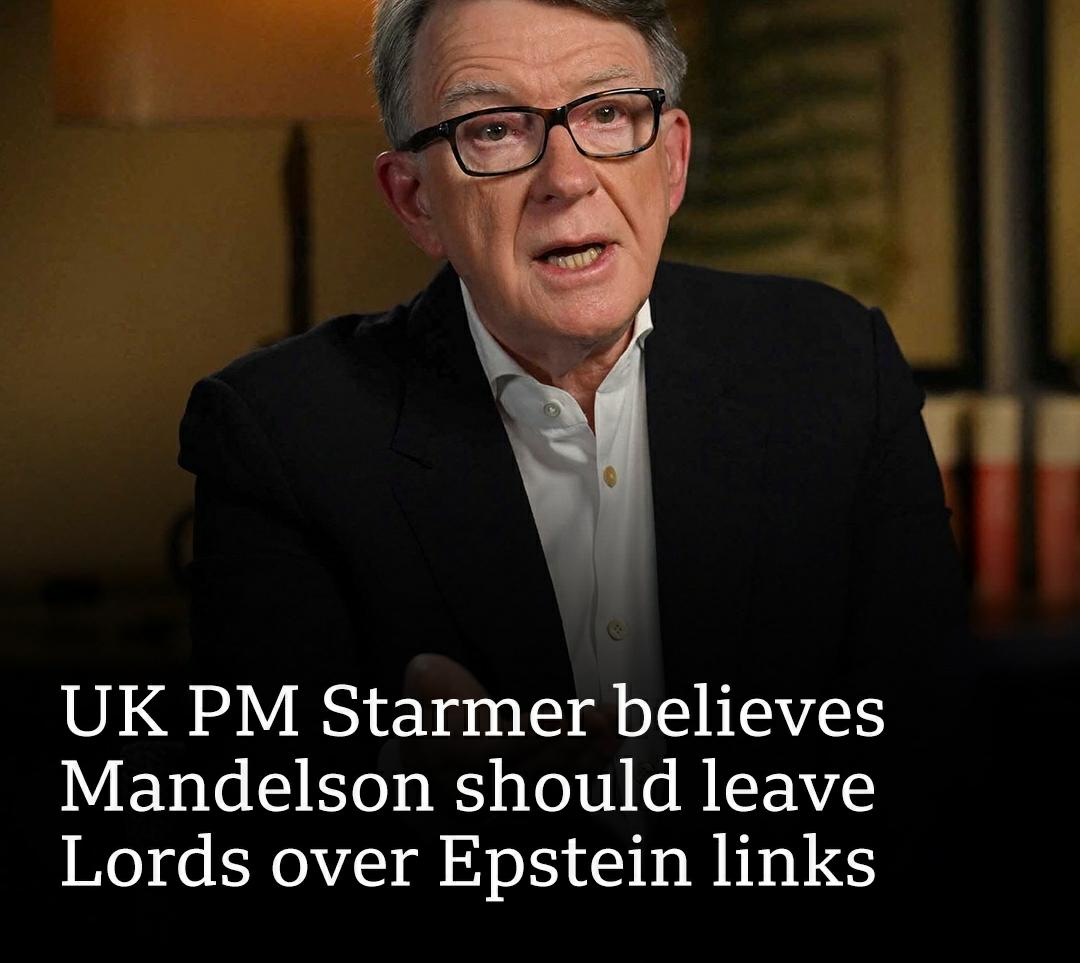
Starmer Says Mandelson ‘Should Not Be a Member of the House of Lords’ London, UK (Feb 2, 2026) British Prime Minister Sir Keir Starmer has publicly stated that Lord Peter Mandelson should no longer sit in the House of Lords nor use his title following renewed revelations about Mandelson’s links to the late convicted paedophile financier Jeffrey Epstein. A Downing Street spokesperson confirmed that although Starmer believes Mandelson should not retain his peerage, the prime minister does not have the legal power to strip a peer of a title under current law without reform. The government has called for reforms to the Lords’ disciplinary procedures to enable removal of peers who bring the institution into disrepute.
Starmer’s remarks come amid intense political scrutiny and media coverage of previously undisclosed documents that have surfaced in the United States. The controversy has been reignited by U.S. Department of Justice documents recently released and reported by
Emails from 2009 show Lord Mandelson, while serving as UK Business Secretary, appeared to communicate with Jeffrey Epstein about influencing government policy.
Records suggest payments totalling around $75,000 (£54,735) were made by Epstein to accounts linked to Mandelson in the early 2000s.
Epstein is also reported to have funded an osteopathy course for Mandelson’s husband in 2009.
The government has tasked the Cabinet Secretary with urgently reviewing these new documents and the extent of Mandelson’s ties to Epstein while the peer was a senior government minister.
Amid the growing scandal, Lord Mandelson resigned his membership of the Labour Party, saying he did not want to “cause further embarrassment” over his connections to Epstein.
Mandelson had earlier been dismissed as the UK’s ambassador to the United States after earlier disclosures about his historical connections to Epstein surfaced.
Despite the resignation from the party, he remains on leave of absence from the House of Lords, which means he is not currently active in parliamentary duties but still retains his peerage title.
Starmer’s stance has triggered a broad political reaction:
The Conservative Party has called for a full independent inquiry into Mandelson’s links with Epstein and raised questions about his appointment as ambassador.
Some senior figures and commentators have argued that the House of Lords must be reformed so it can remove peers whose behaviour is inconsistent with public expectations of propriety.
Downing Street insists that modernising the disciplinary mechanisms of the Lords is necessary, since a peerage can currently only be removed through new primary legislation, a process last used over 100 years ago on Members of the nobility for wartime treason.
The developments mark a significant moment in UK politics, highlighting: Accountability pressures on senior political figures arising from historical associations with notorious individuals like Jeffrey Epstein. The limits of executive action versus institutional reform Starmer can express his position but cannot unilaterally strip a peerage under current UK law.
Ongoing debates over ethics, transparency and reform of parliamentary institutions in the wake of public scandal.
Sir Keir Starmer’s comments and the government’s actions underscore the political sensitivity of the issue and the broader call for parliamentary integrity.