‘SMILING’ FOSSIL FOUND ON HOLY ISLAND NORTHUMBERLAND
‘SMILING’ FOSSIL FOUND ON HOLY ISLAND, NORTHUMBERLAND
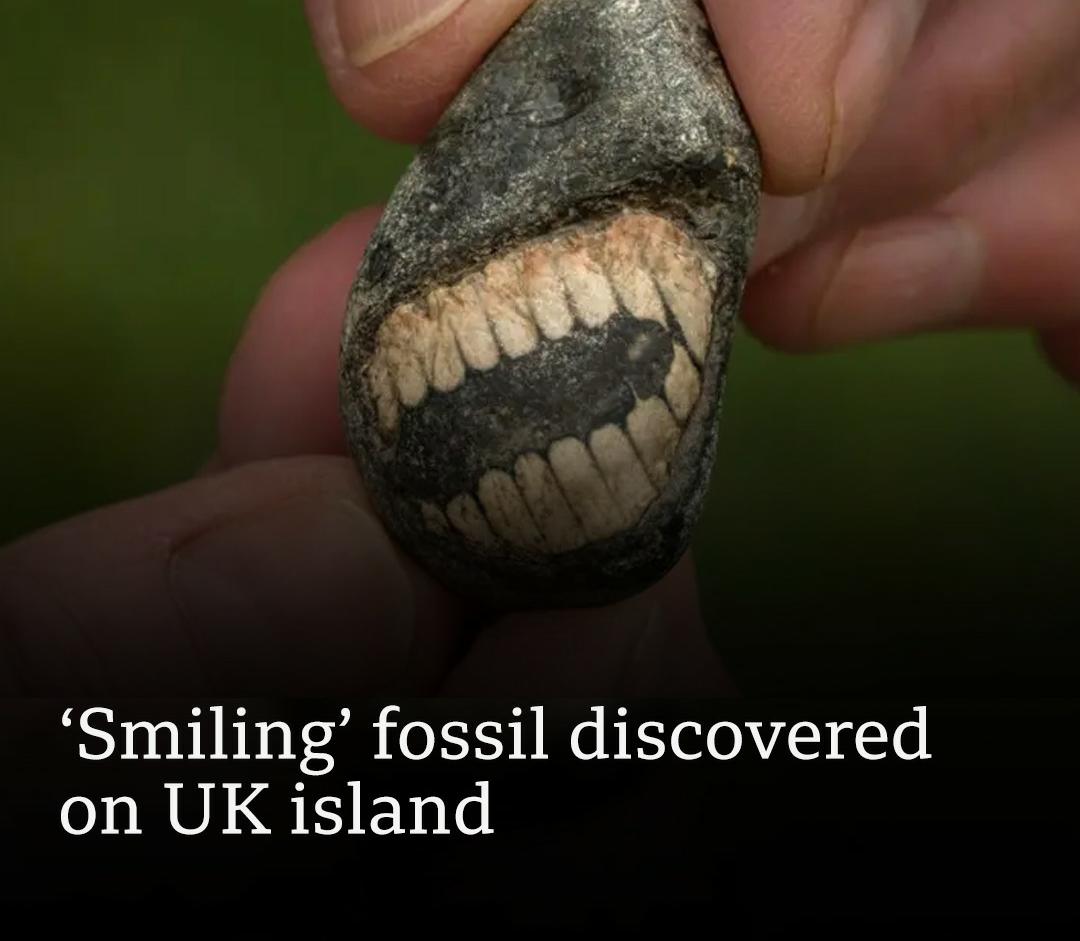
A fossil that appears to be smiling like it has teeth was discovered on The Holy Island of Lindisfarne in Northumberland, England sparking widespread curiosity and amusement after being shared on social media and confirmed by scientists as an ancient marine fossil. The unusual fossil was spotted by Christine Clark, 64, during a Boxing Day walk on the beach while holidaying on Holy Island with her husband. She initially thought the pebble‑sized object looked like “someone’s fake teeth” because of its grin‑like features.
Clark later posted photos of the find on a Facebook fossil identification group, where it quickly attracted attention and thousands of reactions from enthusiast collectors and experts.
After examination with help from the BBC and the British Geological Survey (BGS), the fossil was identified as a piece of a crinoid stem an ancient marine animal. Crinoids are sea creatures that appeared in the Cambrian period over 500 million years ago and are still found today in deep oceans.
The specific fossil consists of multiple disc‑like segments called ossicles connected in sequence a rare preservation known as a columnal. The stem had split lengthways and became curved in such a way that it resembles a mouth‑like shape, giving the impression of a prehistoric smile. Experts think the fossil comes from the Alston Formation, a type of limestone roughly 350 million years old a time when large crinoid populations thrived in ancient seas that once covered the area. Crinoid fossils are well known around Northumberland and locally nicknamed “St Cuthbert’s beads” a reference to the medieval saint associated with Lindisfarne. These columnal fossils were historically threaded into necklaces or rosaries and thought to hold spiritual significance for early residents. Crinoids have a flexible stem attached to the sea floor, topped with a crown of arms that filtered plankton from the water a body plan that earned them the common name “sea lilies.”
The “smiling” fossil has captured public imagination because of its striking resemblance to a face with teeth. Clark said she has received offers to buy the fossil, though she plans to keep it in her own collection. She noted that it has brought a lot of amusement to many people. Scientific significance: The fossil links people today with marine life from hundreds of millions of years ago.
Local heritage: The find adds another chapter to the long tradition of fossil hunting on Holy Island, a site rich in both human and natural history. Public engagement: The unusual appearance has helped spark public interest in palaeontology and the prehistoric past beneath modern landscapes.