Chancellor Rachel Reeves Delivers Spring Statement On The UK Economy
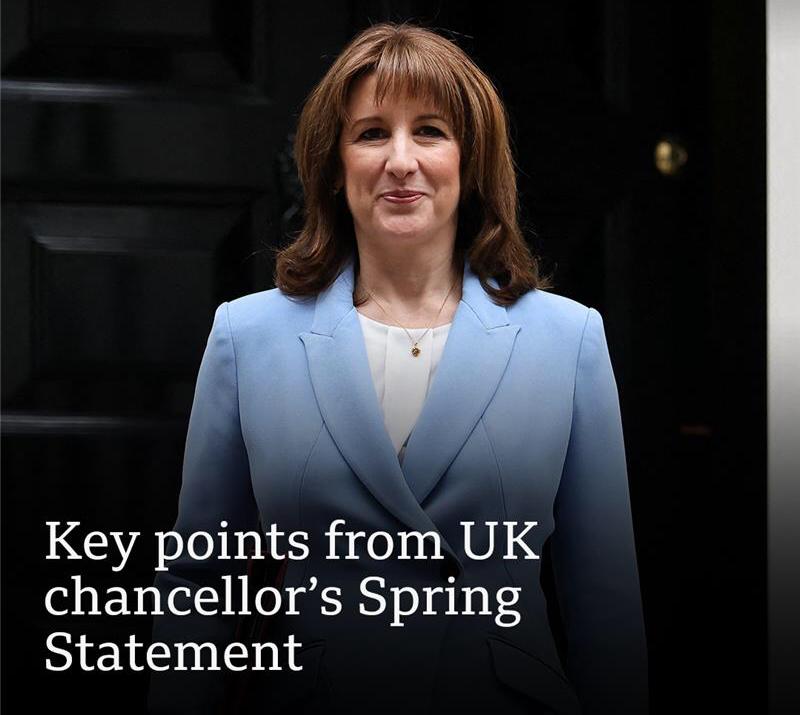
Chancellor Rachel Reeves Delivers Spring Statement on the UK Economy Britain’s Chancellor of the Exchequer, Rachel Reeves, today delivered her annual Spring Statement to Parliament offering the public and markets an update on the UK’s economic outlook, official forecasts and the government’s fiscal position amidst global uncertainty. In a speech that emphasised stability and long‑term planning rather than new tax or spending measures, Reeves outlined key projections from the independent Office for Budget Responsibility (OBR) and reiterated her government’s economic strategy.
The OBR revised its economic growth forecast for 2026 downward to 1.1 %, compared with the previous estimate of 1.4 %, reflecting weaker economic momentum late last year. Growth is then expected to strengthen to 1.6 % in both 2027 and 2028, with steady expansion into 2029 and 2030.
Unemployment is projected to peak at around 5.3 % in 2026 before gradually falling to about 4.1 % by the end of the forecast period. Inflation is expected to fall more quickly than earlier forecasts, which could help ease cost‑of‑living pressures, while recent interest rate cuts by the Bank of England have lowered household borrowing costs. The UK’s public sector net borrowing is forecast to decline steadily from about 4.3 % of GDP this year to roughly 1.8 % by 2030, £18 billion lower than previous outlooks.
The government’s fiscal headroom the buffer under its self‑imposed financial rules increased from £21.7 billion to £23.6 billion, reassuring financial markets about the sustainability of UK public finances.Reeves made it clear that the Spring Statement would not introduce new fiscal policies or tax changes, reserving those for the main Autumn Budget to maintain economic stability.
On housing and mortgages, she highlighted that average mortgage costs for new fixed‑rate deals have fallen by roughly £1,300 a year due to base rate cuts, and reaffirmed the government’s commitment to supporting affordable housing.
Reeves acknowledged that global geopolitical tensions particularly the ongoing war in the Middle East create uncertainty for growth, inflation and energy prices, underscoring her cautious tone. Economists have warned such conflicts could put upward pressure on inflation and constrain growth if energy costs surge.
The Chancellor used the Spring Statement to argue that her government’s economic strategy is the right one for Britain, focusing on safeguarding public finances, fostering growth and reducing borrowing. She also defended recent policies on energy cost containment, childcare support and benefit reforms as part of a broader effort to ease the cost‑of‑living squeeze.
Growth Slower in the short term but strengthening in later years.
Jobs: Unemployment set to peak and then decline.
Inflation Expected to continue falling, potentially prompting further interest rate cuts. Public Finances: Borrowing on track to fall and fiscal rules comfortably met.