At The World Economic Forum In Davos
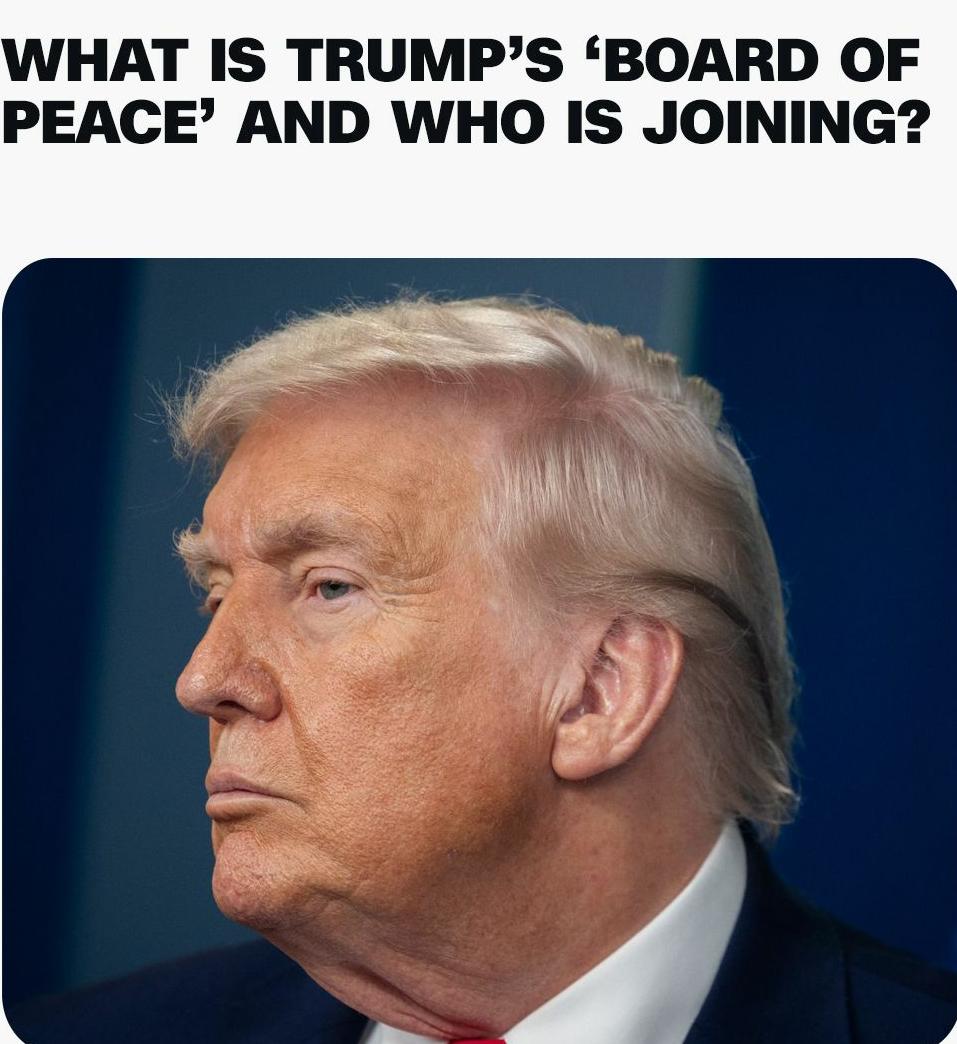
Davos, Switzerland / January 2026
At the World Economic Forum in Davos, U.S. President Donald Trump is promoting an ambitious international diplomatic body called the “Board of Peace” intended to oversee conflict resolution starting with Gaza and (in Trump’s vision) extending to other global disputes. While Trump touts it as a new way to achieve peace, the initiative has met significant resistance from many traditional Western allies.
The Board of Peace is a U.S.-led international body initially proposed to help manage the ceasefire, reconstruction, and governance in Gaza after the Israel-Hamas war. Trump has expanded its scope to potentially tackle global conflicts and has championed it as a faster, more effective alternative to existing multilateral institutions like the United Nations Security Council. Trump chairs the board and and its draft charter would give him unusual powers over membership and direction. Support From Some Non-Western LeadeSeveral countries especially in the Middle East, Central Asia and beyond — have formally agreed to participate: Saudi Arabia, Egypt, United Arab Emirates, Jordan, Qatar, Turkey, Pakistan, Indonesia all announced they would join the board. Argentina, Hungary, Morocco, Kazakhstan, Uzbekistan and Vietnam have also confirmed their participation.
These nations often framed their support in terms of shared goals for a lasting ceasefire in Gaza and broader regional stability.
Controversial Figures Accepting Invitations
The board’s membership has drawn criticism because it includes leaders associated with authoritarianism or those who face legal scrutiny: Israeli Prime Minister Benjamin Netanyahu — agreed to join despite an active International Criminal Court warrant for alleged war crimes related to Gaza actions, drawing criticism from international observers. Belarusian President Alexander Lukashenko, often referred to as one of Europe’s most authoritarian rulers, has also agreed to be part of the initiative. The Independent
Critics say including such figures undermines the credibility of a body intended to promote peace, sparking debate over the board’s true direction and values.
Key Western and democratic countries have so far rejected or declined to join:France, Norway, Sweden, Slovenia have publicly said they will not participate, citing concerns that the board’s broad mandate could undermine the United Nations and established international norms.
Other major powers including the United Kingdom, Germany, China, Russia and the European Commission have been invited but remain undecided or cautious about committing.
Western critics argue the initiative lacks transparency, could weaken existing institutions like the U.N., and appears shaped in ways that centralize power in the U.S. and globally controversial actors.
The Board of Peace stems from Trump’s 20-point peace plan for Gaza and reflects his broader skepticism toward multilateral institutions he says have failed to bring peace. Critics see this as part of a pattern of U.S. unilaterally reshaping global governance frameword
The initiative also comes at a time of transatlantic strain between Trump and European allies, who have disagreed with multiple U.S. policy stances, from Greenland acquisition rhetoric to peace process strategies. President Trump’s “Board of Peace” is highly polarizing: it has found backing among many Middle Eastern and non-Western leaders, but traditional Western allies have resisted participation, largely over concerns about legitimacy and the potential erosion of the U.N.-led international order. The inclusion of leaders facing significant controversies has heightened global debate over whether the initiative can truly serve as a credible platform for peace or is instead serving geopolitical and strategic interests.