250-million-year-old Fossil Reveals First Proof Mammal Ancestors Laid Eggs
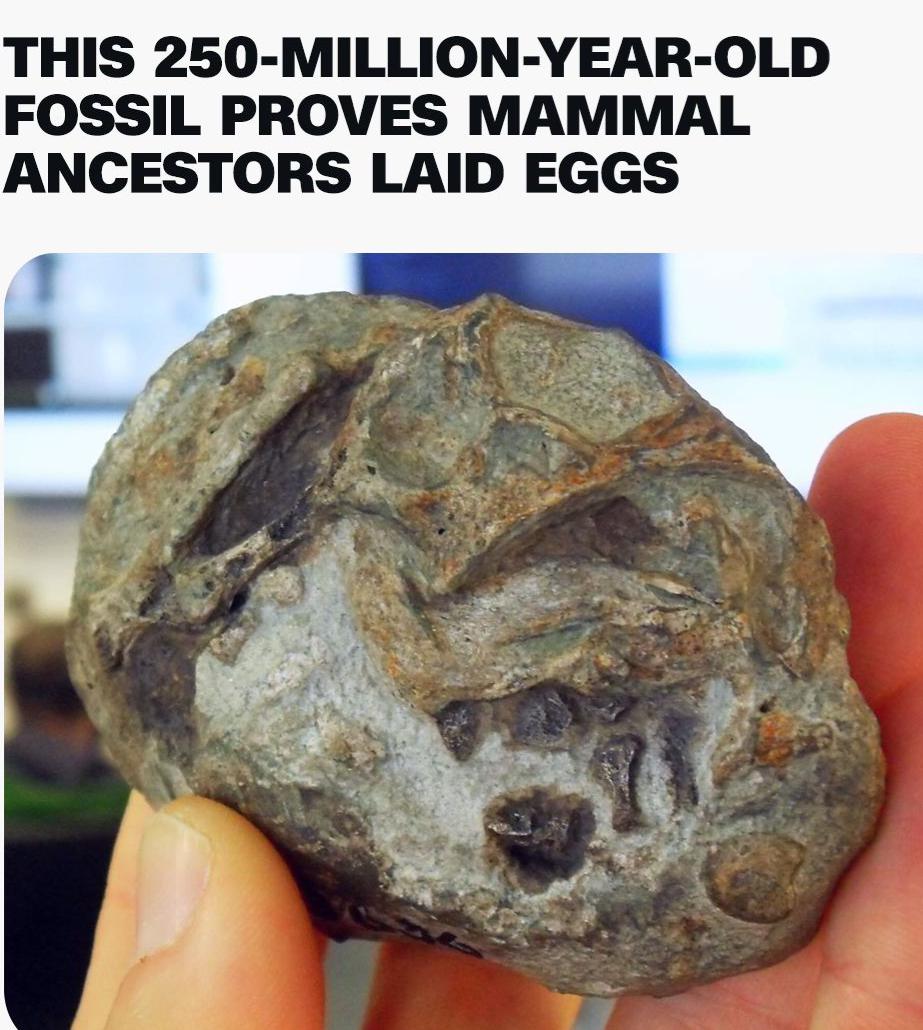
250-million-year-old fossil reveals first proof mammal ancestors laid eggs Embryo of ancient Lystrosaurus confirms egg-laying reproduction and offers clues to survival after Earth’s worst mass extinction Scientists have confirmed the first direct evidence that mammal ancestors laid eggs, following the detailed analysis of a 250-million-year-old fossil containing a curled embryo of an ancient species known as Lystrosaurus. The fossil, found in South Africa and studied using advanced X-ray CT and synchrotron imaging, shows an embryo preserved in a position consistent with development inside an egg. Researchers concluded the animal died before hatching, marking the earliest confirmed case of egg-laying in the mammal lineage. The discovery helps answer a long-standing evolutionary question about how early mammal relatives reproduced and provides new insight into how they survived the aftermath of the End-Permian mass extinction, known as “The Great Dying.”
- Fossil dated to about 250 million years ago
- Species identified as Lystrosaurus, a mammal ancestor (therapsid group)
- Embryo found in a curled, pre-hatching position
- Lower jaw not yet fused a key sign of embryonic development
- No hard shell preserved, suggesting a soft, leathery egg
- Evidence confirmed using CT and synchrotron imaging technology
- Study published in PLOS ONE
Researchers say this is the first direct fossil evidence confirming that mammal ancestors laid eggs. While scientists had long suspected early synapsids reproduced this way, no physical proof had ever been found.
Bone development stage of the embryo
- Body posture matching an egg-shaped enclosure
- Lack of jaw fusion, meaning it could not feed independently
- Geological size and structure consistent with an egg
The study also sheds light on why Lystrosaurus became one of the dominant land animals after the mass extinction that wiped out around 90% of life on Earth.
Researchers suggest its reproductive strategy may have helped survival:
- Large, yolk-rich eggs likely supported early development
- Hatchlings were probably “precocial” (able to survive quickly after birth)
- Soft-shelled eggs may have reduced water loss in harsh, dry conditions
- Fast growth and early independence helped it thrive in unstable climates
Lystrosaurus was a pig-sized herbivore with a beak and tusks, belonging to a group of extinct relatives of mammals known as therapsids. Although not a direct mammal, it sits close to the evolutionary branch that eventually led to modern mammals, including humans. Modern egg-laying mammals such as the platypus and echidna show that egg reproduction still exists in the mammalian lineage today, but this fossil pushes that trait far deeper into evolutionary history.
How reproduction evolved in early mammal ancestors
- Why some species survived mass extinction events
- How environmental pressure shapes survival strategies over time
Researchers say studying ancient survival patterns could also offer clues about how species today might respond to climate stress and ecological collapse.
- Egg-laying confirmed in mammal ancestor lineage for first time
- Soft-shelled eggs may have helped ancient species survive extinction
- New fossil reshapes understanding of early mammal evolution